
Polymarket copy trading
Polymarket copy trading at the prices you could really get.
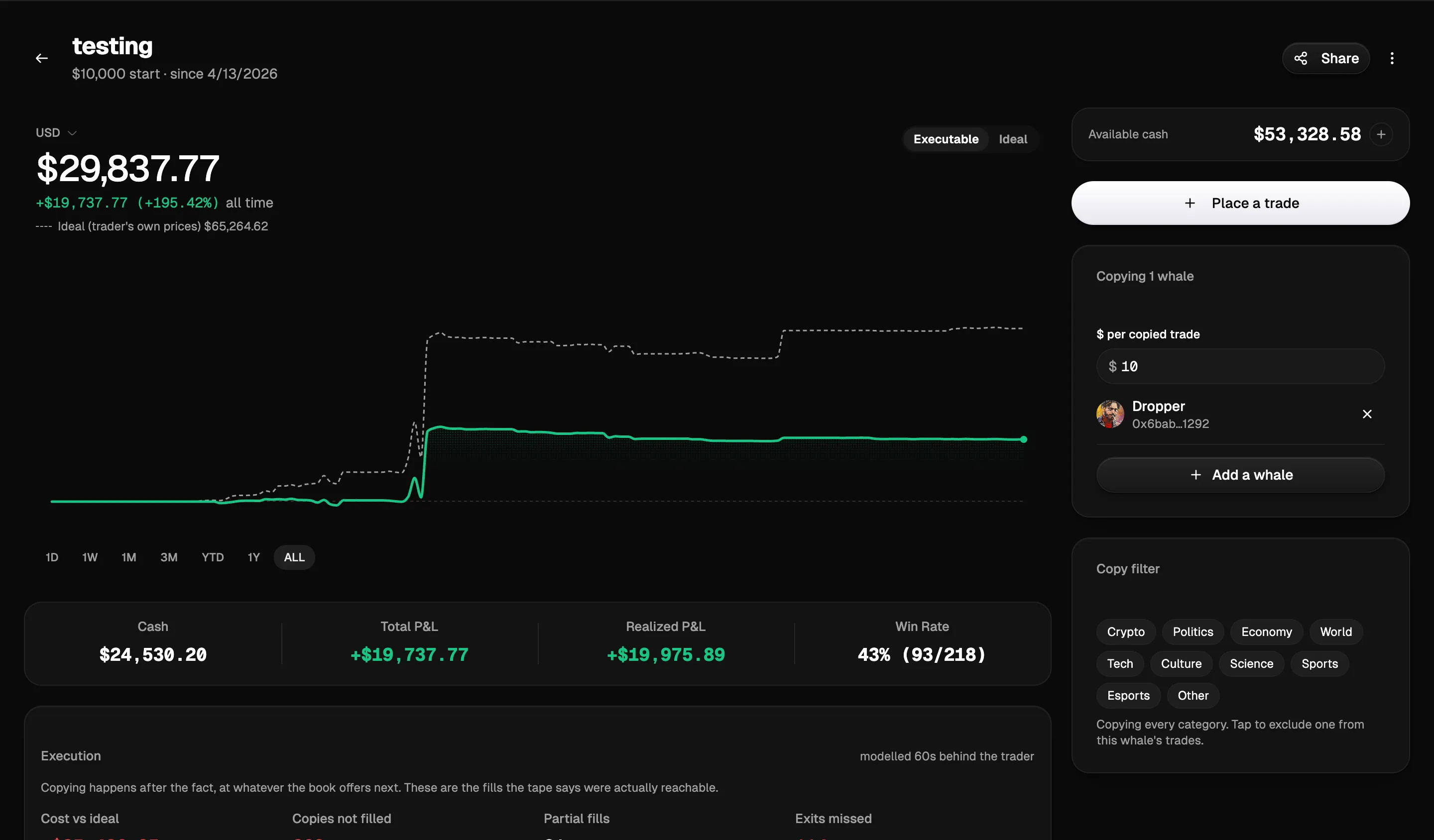
Pick any Polymarket wallet and Orca mirrors its trades into a paper portfolio at the size you choose. Each copy is priced at what was actually on offer a minute after the whale traded, so you see what following them could have earned, not just what they made.
How it works
From a wallet to a portfolio in four steps.
01
Pick the traders
Search any Polymarket wallet by name or address, or find one on Polywhaler's Smart Money leaderboard. One portfolio can copy up to 10 traders.
02
Set your size
Copy every trade at a fixed dollar amount, or at a percent of the trader's own order with an optional cap, so their conviction bets get bigger copies than their test orders. Each trader can have their own size.
03
Choose a start date
Start copying today, or 30 or 90 days back to see how the same traders would have done since then. Either way, the portfolio keeps running forward.
04
Let it run
When a trader buys, your portfolio buys. When they sell, it sells the same fraction. Resolved markets settle on their own, winners at $1 a share and losers at $0, and you can leave out categories such as sports.
Honest fills
Two prices for every copy.
A trader's own fills aren't yours to copy. You arrive after them, into a market they have already moved. So Orca prices every copy twice, and the whole portfolio switches between the two.
Executable, the default, prices each copy against the trades that actually printed after the whale's, starting 60 seconds later, with Polymarket's taker fee and minimum order size. If nothing was reachable, the copy doesn't happen. It is the number for deciding whether to follow someone.
Ideal prices each copy at the trader's own fill. It is the number for judging the trader, and usually the higher one. A big gap between the two means their edge is speed, which a copier can't have. How executable fills work

Paper and live
Copy on paper. Trade live by hand.
Fees and limits
What it costs, and where it stops.
- Orca fees
- None. Paper trading is free, and Orca adds 0% to live orders.
- Venue fees
- Polymarket charges a taker fee on some markets, and Executable copies pay it.
- Plans
- A free account includes one paper portfolio with copying. Pro adds unlimited portfolios and live trading for $9 a month or $59 a year, with a 7-day free trial for new subscribers.
- Traders
- Up to 10 in one portfolio, each with its own size if you like.
- Timing
- Copies are modelled 60 seconds behind the trader, about how long Orca takes to see a new trade.
- Skipped copies
- A copy is skipped when the portfolio runs out of paper cash. Percent copies under $1 are skipped too.
- Wallets
- Copying follows Polymarket wallets. Kalshi markets can be paper traded by hand in the same portfolio.
- Live trading
- Manual on both venues: Orca never places a real order you didn't confirm. How live trading works
FAQs
Common questions about copy trading Polymarket wallets on Orca: what gets copied, at what size, and what it costs.
What is Polymarket copy trading?
Copy trading means mirroring another trader: when they buy, you buy, and when they sell, you sell. Polymarket trades settle on a public blockchain, so every wallet's history is visible, and Orca uses it to copy any wallet into your portfolio at a size you choose.
Is Orca a Polymarket copy trading bot?
On paper, yes: Orca mirrors every trade the wallets you follow make into your paper portfolio, with nothing for you to do. It doesn't run a bot on your real money. Live portfolios only place orders you confirm, and Polymarket orders are signed in your own wallet, so Orca never needs your private key.
Can Orca copy trades with real money?
Not automatically. Copying runs in paper portfolios, where you can see what following a trader would have earned before you risk anything. To trade for real, open a live portfolio on Polymarket or Kalshi and place the orders yourself. Live trading is included with Pro, and Orca charges no fee on it.
How big is each copied trade?
You choose. Copy every trade at a fixed dollar amount, or at a percent of the trader's own order with an optional cap per copy, and give each trader their own size if you like. When the trader sells, your copy sells the same fraction.
Why is my copy's return lower than the whale's?
Because you trade after them. Orca's default Executable view prices each copy at what was actually on offer 60 seconds after the whale's trade, including Polymarket's taker fee where a market charges one, and some copies can't fill at all. The Ideal view shows the trader's own prices for comparison.
Which traders can I copy?
Any Polymarket wallet, found by name or address, up to 10 in one portfolio. Polywhaler's Smart Money leaderboard is a good place to find them. Copying follows Polymarket wallets; Kalshi markets can be traded by hand in the same paper portfolio.
Is copy trading on Orca free?
Yes. A free account includes one paper portfolio with copying and no limit on the trades inside it. Pro adds unlimited portfolios and live trading for $9 a month or $59 a year.
More on Orca.